Check patterns in real time
Surface a warning as the rota changes instead of waiting for a separate manual review.

FlowRota checks employee shift patterns against the working rules applied to the rota and alerts managers when a schedule may need changing.
Highlight insufficient rest between shifts, excessive shift duration and missing breaks while the manager still has the rota in front of them—not after the schedule has reached staff.
Working-time problems often come from the relationship between shifts rather than one shift viewed alone. FlowRota checks the employee’s pattern as managers build the week and surfaces a warning where the rota can still be reviewed and corrected.
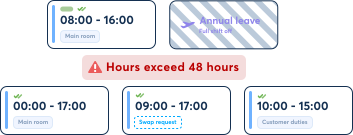
Rules and warnings give managers a chance to investigate a problem before the working pattern becomes the employee’s published rota.
Surface a warning as the rota changes instead of waiting for a separate manual review.
Flag when the gap between one shift ending and the next starting is too short.
Warn when a shift exceeds the maximum duration applied to that working rule.
Compare shift duration with its recorded break and highlight a potential shortfall.
Review the warning against the person’s actual sequence of scheduled work.
Explain what needs attention without silently rewriting the rota.
FlowRota places working-rule feedback inside the scheduling workflow, where the manager can compare the employee’s shifts and respond.
A shift can look reasonable on its own but create a problem when combined with the employee’s previous work, its total duration or an insufficient break. Real-time checks connect those facts and bring the risk to the manager’s attention.
Features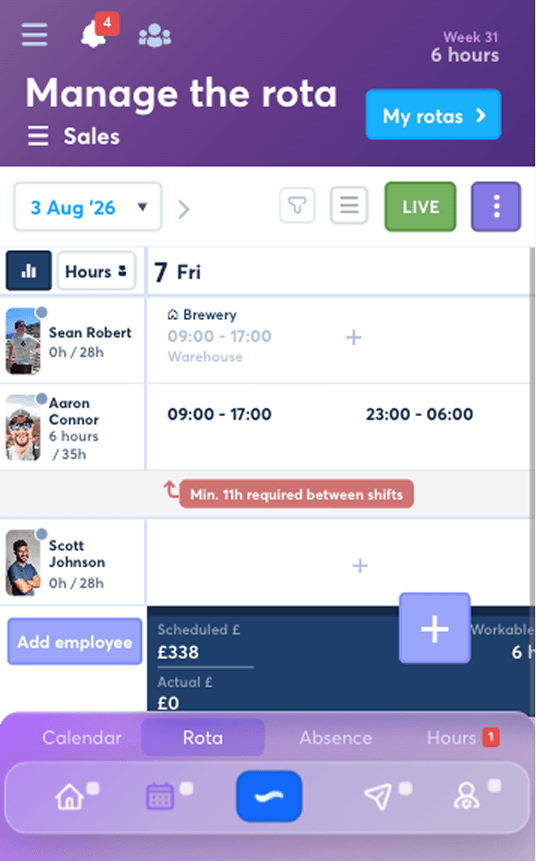
FlowRota can compare different parts of an employee’s schedule against the working rules that apply.
Compare the finish of one shift with the start of the employee’s next shift.
The check considers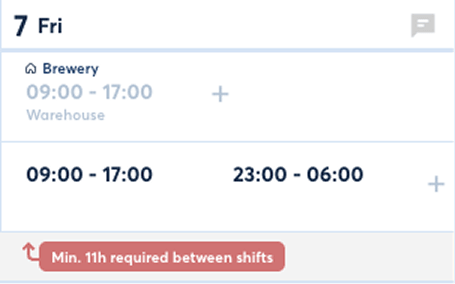
Benefit: Catch a difficult close-then-open pattern even when the shifts sit on different rota days.
Flag a shift when its scheduled duration exceeds the maximum applied by the relevant local or organisational rule.
The check considers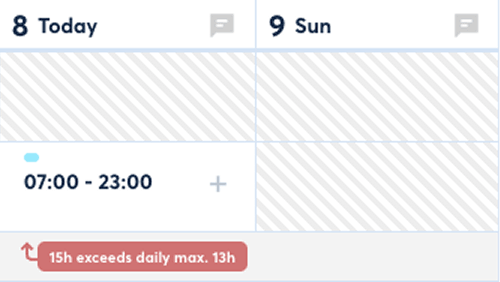
Benefit: Make unusually long work visible before it becomes an accepted part of the schedule.
Compare the scheduled duration with the break recorded against the shift and warn when the applicable rule may not be met.
The check considers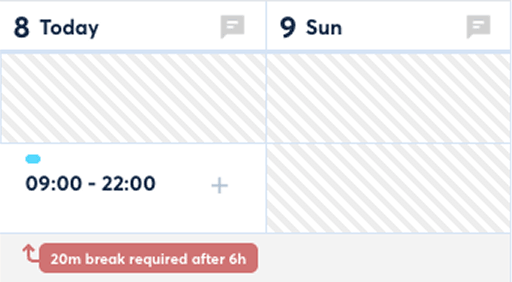
Benefit: Avoid treating break time as an afterthought once the week has already been published.
The check follows the employee’s scheduled times and the working rule relevant to the pattern.
A shift is added, extended, moved or given a break within the employee’s rota.
The shift and surrounding schedule are compared with the working rules applied to the rota.
The manager sees a warning when the schedule falls outside the relevant rest, duration or break rule.
They check the employee, rule and any applicable exception before deciding how the rota should change.
 A warning supports the decision; it does not make it.
Managers remain responsible for applying the correct rules and
understanding exceptions.
A warning supports the decision; it does not make it.
Managers remain responsible for applying the correct rules and
understanding exceptions.
Working-time requirements are not identical everywhere or for every employee. Age, industry, night work, agreements, opt-outs and compensatory-rest arrangements can all affect what applies.
FlowRota checks the rota against the working rules applied to the organisation, helping managers identify patterns that may conflict with those requirements.
Useful for reviewingA warning cannot know every employment agreement or legal exception in isolation. The manager must confirm what applies to the employee and work involved.
Review may includeFlowRota helps identify a schedule that needs attention. It does not certify legal compliance or decide whether a particular exemption, agreement or alternative rest arrangement is valid.
For most adult workers, current GOV.UK guidance includes the examples below. Different rules and exceptions can apply, so the official guidance should be checked for the employee and work involved.
| UK example | General position | What a rota warning can prompt |
|---|---|---|
| Rest during a shift | Adult workers are usually entitled to one uninterrupted 20-minute break when working more than six hours. | Review a long shift with no break or too little break. |
| Daily rest | Adult workers are usually entitled to 11 hours’ rest between working days. | Review two shifts with an insufficient gap between them. |
| Average weekly hours | The usual limit is an average of 48 hours a week, normally calculated over 17 weeks, subject to opt-outs and exceptions. | Review whether the wider pattern needs an averaged-hours calculation rather than treating one long week as conclusive. |
| Night work | Night workers are generally limited to an average of eight hours in each 24-hour period, with additional rules for hazardous work. | Review a night-working pattern against the correct rule. |
Read the official GOV.UK guidance on rest breaks at work , maximum weekly working hours and night working hours .
The warning is most valuable when the manager can see why it appeared and review the same rota that created it.
Depending on the issue, the manager may move a start time, shorten a shift, increase its break, reassign work or investigate whether a valid exception applies.
Manager review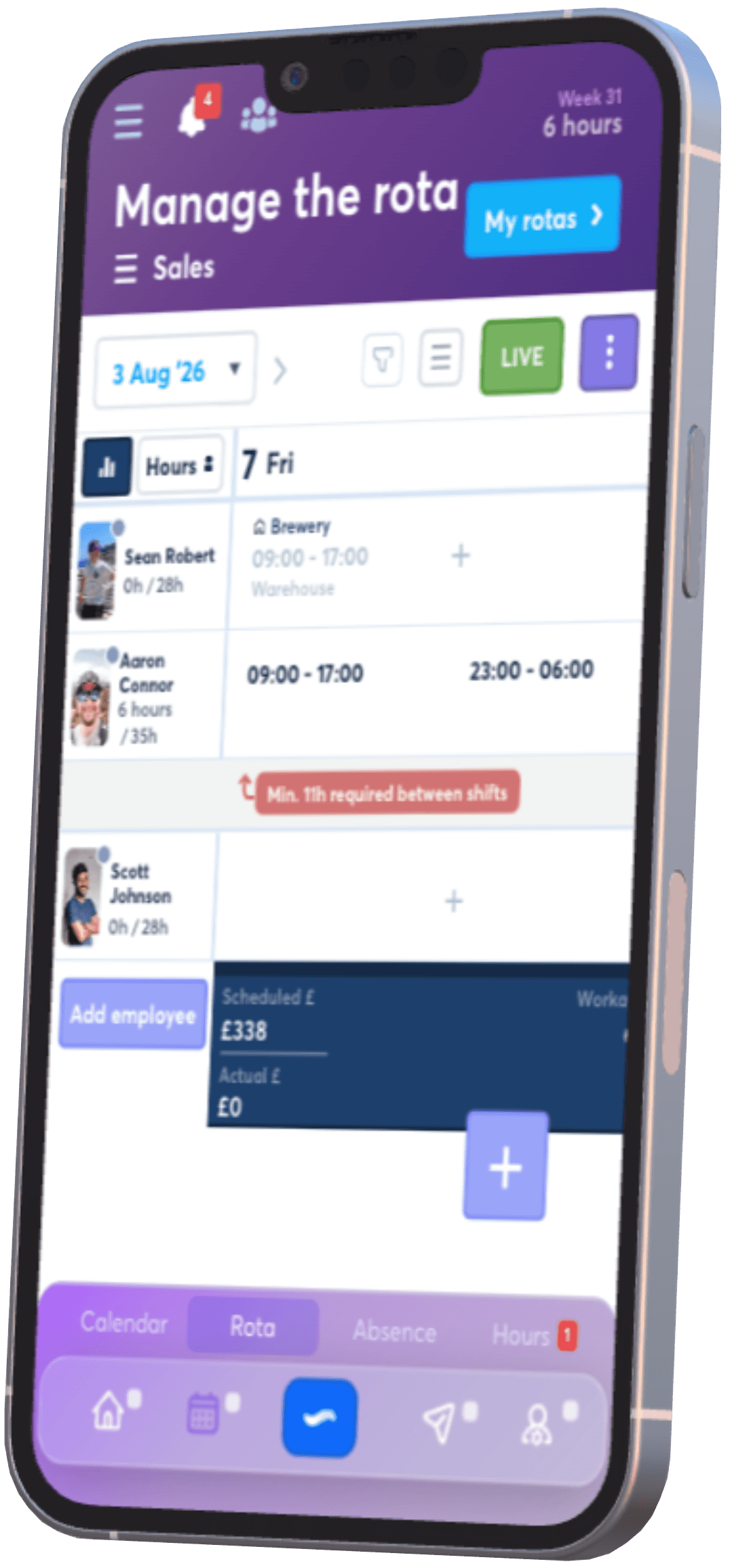
A risky working pattern is easier to correct before it is published, staffed and used as the basis for day-to-day operations.
Surface a possible rule problem while the manager can still amend the week.
Reduce the need to compare every finish time, start time and break by hand.
Give managers a visible issue to review rather than assuming the software has made the legal decision.
Publish schedules with fewer avoidable rest, duration and break problems.
Rule checks work alongside conflict alerts, employee records and reporting to give managers a clearer view of the schedule.
FlowRota checks employee shift patterns against the working rules applied to the rota and alerts managers to potential problems.
Yes. Warnings appear in the rota while the manager is scheduling, so the pattern can be reviewed before it is relied upon.
Yes. FlowRota can warn when the gap between an employee’s shifts falls below the applicable minimum rest rule.
Yes. The rota can alert managers when a shift’s duration and recorded break do not meet the applicable break rule.
Yes. Where a maximum shift-duration rule applies, FlowRota can flag a shift that exceeds it.
No. Rules can vary by jurisdiction, age, role, industry, night work, opt-out status and other exceptions, so managers must review each warning in context.
No. A warning identifies a pattern that needs review. It does not replace legal advice or determine whether an exemption, agreement or compensatory-rest arrangement applies.
No. The warning gives the manager the information needed to review the pattern and make the appropriate scheduling decision.
Common UK examples include daily rest between working days, rest breaks during longer shifts, average weekly working hours and limits applying to night or young workers.
FlowRota costs £1 per user per month after a 30-day free trial. No credit card is required to start the trial. Visit the pricing page for full details.
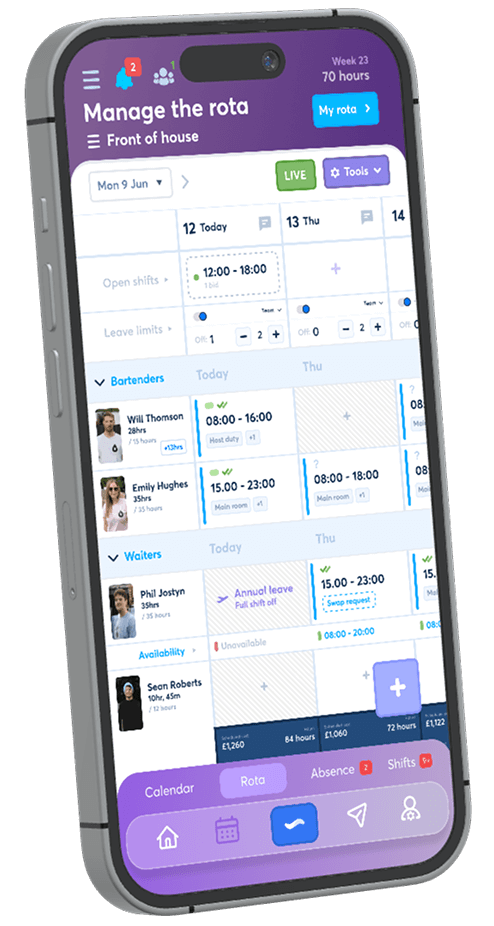
Build the week, review real-time warnings and correct risky shift patterns while the schedule is still in front of you. The trial is free for 30 days, no credit card is required, and continued access costs just £1 per user per month.
Start your free trial